

Procurement, Selection, and Engineering Applications
Professional Reference for Stainless Steel Wire Mesh
During the procurement of stainless steel wire mesh products, customers typically need to confirm key factors such as material, mesh count, aperture, wire diameter, weaving method, filtration accuracy, dimensional tolerances, packaging method, and operating environment.
To help customers select suitable products more efficiently, we have compiled product specification references, industry terminology explanations, and frequently asked questions. Whether you are procuring standard wire mesh, custom filter components, or looking for a long-term supplier for an industrial project, you can find basic technical information here.

Product Specifications
Stainless Steel Wire Mesh Product Specification Reference
The performance of stainless steel wire mesh depends on the material, wire diameter, aperture, mesh count, weaving method, and subsequent processing methods. Different application scenarios have different requirements for the product's corrosion resistance, strength, filtration accuracy, air permeability, temperature resistance, and service life.
This page provides a reference for common stainless steel wire mesh specifications to help customers more accurately confirm their needs before inquiring, selecting, and customizing production.
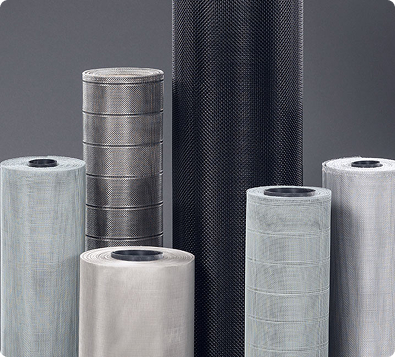
Commonly Used Stainless Steel Materials
| Material | Corrosion Resistance | Magnetic Properties | Core Advantages | Typical Applications |
|---|---|---|---|---|
| 201 | Fair | Slightly magnetic, especially after cold working | Lower cost | Indoor decoration, dry area railings |
| 430 | Moderate | Clearly magnetic | Lower cost, good formability | Appliance panels |
| 304 | Good | Usually nearly non-magnetic in the annealed condition; may become slightly magnetic after cold working | Versatile, with a good balance of corrosion resistance and processability | Kitchenware, ordinary wire mesh, outdoor general use |
| 316L | Very Good | Usually nearly non-magnetic; may become slightly magnetic after cold working | Better resistance to chlorides and chemical corrosion | Coastal, chemical, and mining filtration |
| 310S | Good | Usually nearly non-magnetic | Excellent high-temperature oxidation resistance | High temperature furnace filter |
| 420 | Fair | Clearly magnetic | High hardness and wear resistance | Knives and blades |
| 2205 | Excellent | Clearly magnetic | High strength, excellent resistance to pitting and stress corrosion cracking | Seawater and chemical corrosive environments |
| Material | Characteristics | Common Applications |
|---|---|---|
| 201 | Low cost, suitable for general environments | General protection, decoration, low-corrosion environments |
| 304 | High versatility, good corrosion resistance | Industrial filtration, screening, construction, food equipment |
| 304L | Low carbon 304, better weldability | Welded parts, filter components, chemical equipment |
| 316 | Better corrosion resistance than 304 | Marine environment, chemical filtration, humid environment |
| 316L | Low carbon 316, better corrosion resistance and weldability | Food, pharmaceutical, chemical, precision filtration |
| 310S | Good high temperature resistance | High temperature furnace, heat treatment equipment, high temperature filtration |
| 904L | Excellent resistance to strong corrosion | Strong acid, highly corrosive chemical environments |
Note: If the product is used in humid, salt spray, chemical, food, or pharmaceutical environments, 316 or 316L is generally recommended. If the material is uncertain, please provide the intended use environment, and we will assist in selection.
Common Weaving Methods
Plain Weave
Plain weave is the most common structure in stainless steel wire mesh. Warp and weft wires are interlaced, resulting in a regular mesh size and stable structure, suitable for most screening, filtration, and protective applications.
Applicable Scenarios:
- General Filtration
- Particle Screening
- Ventilation and Protection
- Industrial Isolation
- Building Decoration
Twill Weave
Twill weave is typically used for products with thicker wire diameters or higher mesh counts. Its structure is more flexible than plain weave, allowing for higher density weaving.
Applicable Scenarios:
- High-Strength Filtration
- High Mesh Screening
- Industrial Separation
- Precision Equipment Support
Woven Mesh / Dense Weave Mesh
Woven mesh has thicker warp and finer weft wires, resulting in a dense mesh structure and high filtration accuracy. It is commonly used for liquid, gas, and precision particle filtration.
Applicable Scenarios:
- Precision Filtration
- Liquid Filtration
- Gas Filtration
- Chemical Filtration
- Pharmaceutical Equipment
- High-Pressure Filtration
Welded Wire Mesh
Welded wire mesh is made by welding longitudinal and transverse metal wires at their intersections. It has a robust structure and good dimensional stability, and is commonly used for protection, fencing, support, and engineering structures.
Applicable Scenarios:
- Protective Netting
- Fence Netting
- Equipment Protective Covers
- Building Reinforcement
- Industrial Frame Mesh
Crimped Wire Mesh
Crimped wire mesh is woven from pre-bent metal wires, featuring a robust structure and large mesh openings, suitable for screening and protection applications.
Applicable Scenarios:
- Mining Screening
- Grain Screening
- Machinery Protection
- Decorative Mesh
- Heavy Duty Screening
Stainless Steel Wire Mesh Product Specification Reference
Stainless steel wire mesh specifications are typically expressed in terms of mesh count, wire diameter, and aperture.
- Mesh count: The number of openings per inch of wire.
- Wire diameter: The diameter of the braided wire.
- Aperture: The size of the opening between adjacent wires.
- Aperture ratio: The proportion of mesh area to the total area.
Generally speaking:
- Higher mesh count means smaller aperture and higher filtration accuracy.
- Thicker wire diameter means higher strength, but lower aperture ratio.
- Larger aperture means better air permeability and throughput.
Common Specifications Reference Table
| Mesh Size | Common Wire Diameter | Reference Aperture | Common Applications |
|---|---|---|---|
| 2 mesh | 1.5-2.0 mm | Approx. 10-11 mm | Protection, coarse screening, support |
| 4 mesh | 1.0-1.5 mm | Approx. 5-6 mm | Coarse screening, protection, ventilation |
| 8 mesh | 0.5-1.0 mm | Approx. 2-2.5 mm | Sieving, filtration, protection |
| 10 mesh | 0.5-0.8 mm | Approx. 1.7-2.0 mm | Industrial sieving, filtration |
| 20 mesh | 0.3-0.5 mm | Approx. 0.7-1.0 mm | General filtration, screening |
| 40 mesh | 0.18-0.3 mm | Approx. 0.3-0.45 mm | Fine sieving, liquid filtration |
| 60 mesh | 0.12-0.2 mm | Approx. 0.22-0.3 mm | Fine filtration, industrial separation |
| 80 mesh | 0.10-0.18 mm | Approx. 0.15-0.22 mm | Precision sieving and filtration |
| 100 mesh | 0.08-0.12 mm | Approx. 0.13-0.17 mm | Precision filtration |
| 200 mesh | 0.05-0.08 mm | Approx. 0.05-0.08 mm | High-precision filtration |
| 300 mesh | 0.03-0.05 mm | Approx. 0.03-0.05 mm | Fine filtration |
| 400 mesh | 0.025-0.04 mm | Approx. 0.02-0.04 mm | Ultrafine filtration |
Note: The above are common specifications for reference. Actual aperture may vary depending on wire diameter, weaving method, and production standards. It is recommended to confirm the specific mesh count, wire diameter, aperture, and tolerance requirements before purchasing.
Product Forms
We can supply stainless steel wire mesh products in different forms according to customer needs:
- Rolls
- Wire mesh
- Strips
- Square Sheets
- Filter Discs
- Filter Cartridges
- Filter Tubes
- Wire Baskets
- Welded Wire Mesh
- Edged Wire Mesh
- Irregularly Shaped Deep-Processed Parts
If customers already have installation locations or equipment interfaces, they can provide drawings or samples, and we can customize processing according to the dimensions.
Customization Options
We support the following customization options:
- Material customization
- Mesh count customization
- Aperture size customization
- Wire diameter customization
- Width and length customization
- Cutting size customization
- Welded structure customization
- Bending and forming customization
- Edge treatment customization
- Surface treatment customization
- Export packaging customization
Contact Us
Request a Custom Quote
To provide a fast and accurate quotation, please provide the following information:
- Direct Factory Pricing
- Custom OEM Solutions
- Expert Technical Guidance
Fill the form
No spam. Your information is 100% safe · Fast response within 24 hours.
Glossary
Common Terms in the Stainless Steel Wire Mesh Industry
To help customers better understand product specifications and technical parameters, we have prepared a glossary of common terms in the stainless steel wire mesh industry. Whether you are purchasing wire mesh products for the first time or selecting products for an industrial project, these terms can help you communicate more accurately with suppliers.
Mesh
Mesh refers to the number of openings per inch. For example, 20 mesh means there are 20 openings within one inch. The higher the mesh count, the smaller the openings usually are. The lower the mesh count, the larger the openings usually are.
Wire Diameter
Wire diameter refers to the diameter of the metal wire used for woven or welded wire mesh. A thicker wire diameter provides higher product strength, but reduces the open area. Example: 10 si = 0.1 mm.
Aperture / Opening Size
Aperture refers to the opening between adjacent metal wires. The aperture directly affects filtration accuracy, screening performance, and material passing capacity.
Open Area
Open area is the ratio of the open-hole area to the total mesh surface area. A higher open area provides better air permeability, light transmission, and fluid passing capacity.
Micron
Micron is a commonly used unit for filtration accuracy. 1 micron equals 0.001 mm. In precision filtration, customers often use microns to describe filtration requirements.
Filtration Accuracy
Filtration accuracy refers to the particle size range that the wire mesh can retain. It is related to aperture size, weaving method, wire diameter, and mesh surface structure.
Plain Weave
Plain weave is a structure formed by warp and weft wires crossing over and under each other alternately. It is the most common type of stainless steel woven mesh.
Twill Weave
Twill weave is a diagonal weave structure formed by warp and weft wires crossing according to a specific pattern. It is suitable for products with higher mesh counts or thicker wire diameters.
Dutch Weave
Dutch weave mesh is usually woven with thicker warp wires and finer weft wires. It has a dense structure and high filtration accuracy, and is commonly used for pressure filtration and precision filtration.
Welded Wire Mesh
Welded wire mesh is made by welding longitudinal and transverse wires at each crossing point. It has a firm structure and stable dimensions, making it suitable for protection, fencing, support, and engineering applications.
Crimped Wire Mesh
Crimped wire mesh is woven from pre-crimped metal wires. It has high structural strength and is commonly used for mining screening, mechanical protection, and decoration.
Stainless Steel 304
304 is one of the most commonly used stainless steel grades. It has good corrosion resistance, processability, and overall performance, making it suitable for general industrial environments.
Stainless Steel 316
316 stainless steel contains molybdenum, providing better corrosion resistance than 304. It is especially suitable for humid, salt spray, marine, and chemical environments.
Stainless Steel 316L
316L is a low-carbon version of 316 stainless steel. It has better welding performance and resistance to intergranular corrosion, and is commonly used in food, pharmaceutical, chemical, and filter component applications.
Tensile Strength
Tensile strength refers to the ability of metal wire to withstand tensile force. It is very important for protection, support, and high-strength screening applications.
Tolerance
Tolerance refers to the allowable deviation between the actual product size and the designed size. Common tolerances for wire mesh products include length, width, aperture size, wire diameter, and processing dimension tolerances.
Edge Treatment
Edge treatment refers to processes such as edge wrapping, welding, folding, or framing of wire mesh edges to improve safety, structural strength, and installation convenience.
Passivation
Passivation is a surface treatment process that enhances the corrosion resistance of stainless steel surfaces. It is commonly used for products requiring higher surface cleanliness and corrosion resistance.
Polishing
Polishing is used to improve the surface finish of stainless steel, making the product more attractive and easier to clean. It is commonly used for food equipment, decorative mesh, and some filter components.
Mesh Roll
A mesh roll is stainless steel wire mesh supplied in roll form. It is suitable for customers who need to cut the mesh themselves or use it in continuous production.
Mesh Sheet
A mesh sheet is a product cut to fixed dimensions. It is suitable for installation, protection, filtration, and further processing.
Filter Disc
A filter disc is a filter component made by punching or cutting wire mesh into a round shape. It is commonly used in filters, valves, pipelines, and equipment interfaces.
Filter Cylinder
A filter cylinder is a cylindrical filter component made by rolling, welding, or edge-framing wire mesh. It is commonly used for liquid, gas, and particle filtration.
MOQ
MOQ stands for Minimum Order Quantity. It refers to the minimum quantity required for an order. Different materials, specifications, and processing methods may have different MOQs.
Lead Time
Lead time refers to the period from order confirmation to product completion and readiness for shipment. Standard products usually have shorter lead times, while customized products depend on processing complexity.
Frequently Asked Questions (FAQ)
We mainly supply stainless steel woven mesh, stainless steel filter mesh, stainless steel Dutch weave mesh, stainless steel welded mesh, stainless steel crimped mesh, filter discs, filter cylinders, filter tubes, mesh baskets, mesh frames, fence mesh, protective mesh, and various deep-processed wire mesh products.
201, 304, 304L, 316, 316L, 310S and 904L cover almost every enquiry we receive. Other special alloys can be sourced when the operating conditions call for them.
316 contains molybdenum, which gives it better resistance to chlorides. In humid, salt spray, marine or chemical environments 316 or 316L will last considerably longer; for general industrial use 304 is the economical choice.
Start from the particle size you need to hold back and the throughput you need to keep. Tell us both, along with the working pressure, and we will recommend a mesh count and wire diameter to suit.
No. Mesh count is the number of openings per inch; aperture is the size of one opening. Two meshes of the same count but different wire diameters have different apertures.
Yes. Send a drawing, a CAD file, a sample or a photograph with the key dimensions marked and our engineering team will confirm material, tolerances, welding positions and edge treatment before production.
Yes. We punch and cut discs, and roll, weld and edge-frame cylinders and tubes, in single or multi-layer constructions.
Stainless steel resists corrosion but is not immune to it. Surface contamination, chlorides and high temperatures all shorten its life, which is why the grade should be matched to the environment.
Yes. 304 covers general food contact and 316 or 316L is preferred where the medium is acidic, salty or cleaned aggressively.
It depends on the medium, its concentration and the temperature. 316L is the usual starting point, with 904L or duplex 2205 for strongly corrosive conditions.
Yes. Samples are available for specification confirmation, material testing, filtration testing or customer approval.
It depends on the specification. Standard rolls and sheets can often be supplied in small quantities; custom-tooled products carry a higher minimum.
Product name or photo, material, mesh count or aperture and wire diameter, width and length or a drawing, quantity, application scenario, and the port of destination.
Standard specifications are usually ready within one to two weeks. Customized and deep-processed products depend on structure, quantity and processing, and the cycle is confirmed in the quotation.
Yes. Rolls go in waterproof paper, plastic film and wooden crates; sheets on pallets or in crates. Export or project-specific packaging is executed to your requirements.
We support sea freight, air freight, express delivery, and customer-designated freight forwarders.
Every order is inspected against the confirmed specification — material, mesh size, wire diameter, dimensions, weld strength, surface condition and packaging.
Yes. Third-party inspection can be arranged on request, and we will coordinate access and documentation.
Cleaning, polishing and passivation are all available, along with other treatments where the application requires them.
Send us your specifications or drawings. We will quote, confirm the production cycle, and keep you updated through production, inspection and shipment.